A personalized discovery platform for people with curly hair
Client
Curli
Year
2025
Description
Scope of Work
The Problem
Curly hair is not a single hair type. It spans a wide spectrum of textures, porosity levels, densities, curl patterns, and coarseness. This paired with individual preferences makes shopping for curly hair products a challenge, yet most hair care platforms treat it as one monolithic category, or ignore it entirely. Generic product recommendations that work for straight hair are worse than useless for someone with Type 4c coils or low-porosity 3b curls. They waste money, time, and trust.
For many people, hair is more than appearance. It reflects identity, culture, and self-acceptance. Embracing natural curls often comes after years of trial, frustration, and pressure to conform. When the products and advice available don't meet the reality of their hair, the damage is emotional as well as practical.
Research
I used two methods to understand the curly hair user's largest pain-points when it came to finding the right products for their hair:
Market Research to understand the scale and measurability of the problem
Competitive Analysis to map what existing apps and services offer, and where they are falling short
Market Analysis
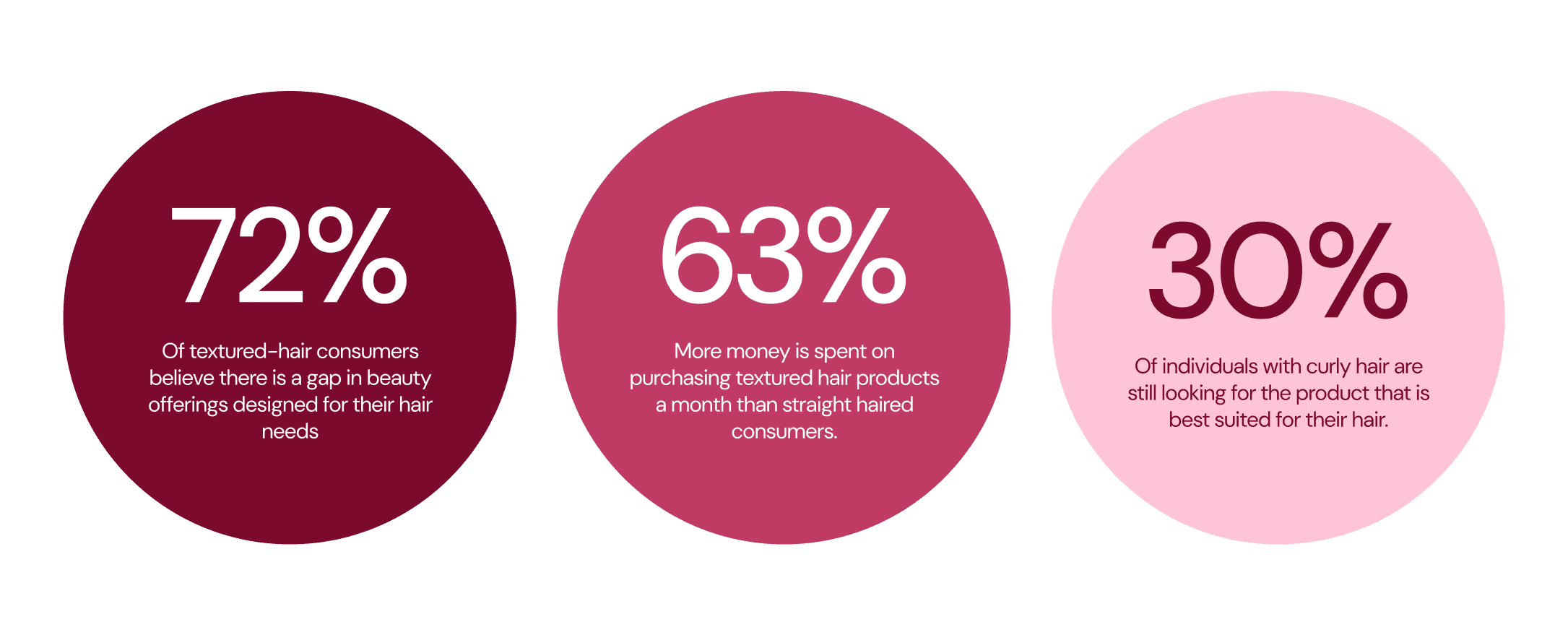
Consumers with curly hair spend significantly more money and time with trial and error to find products that work for them. For many individuals the process of searching for the right hair routine is ongoing with no confidence that a perfect solution is around the corner.
Expert Voice
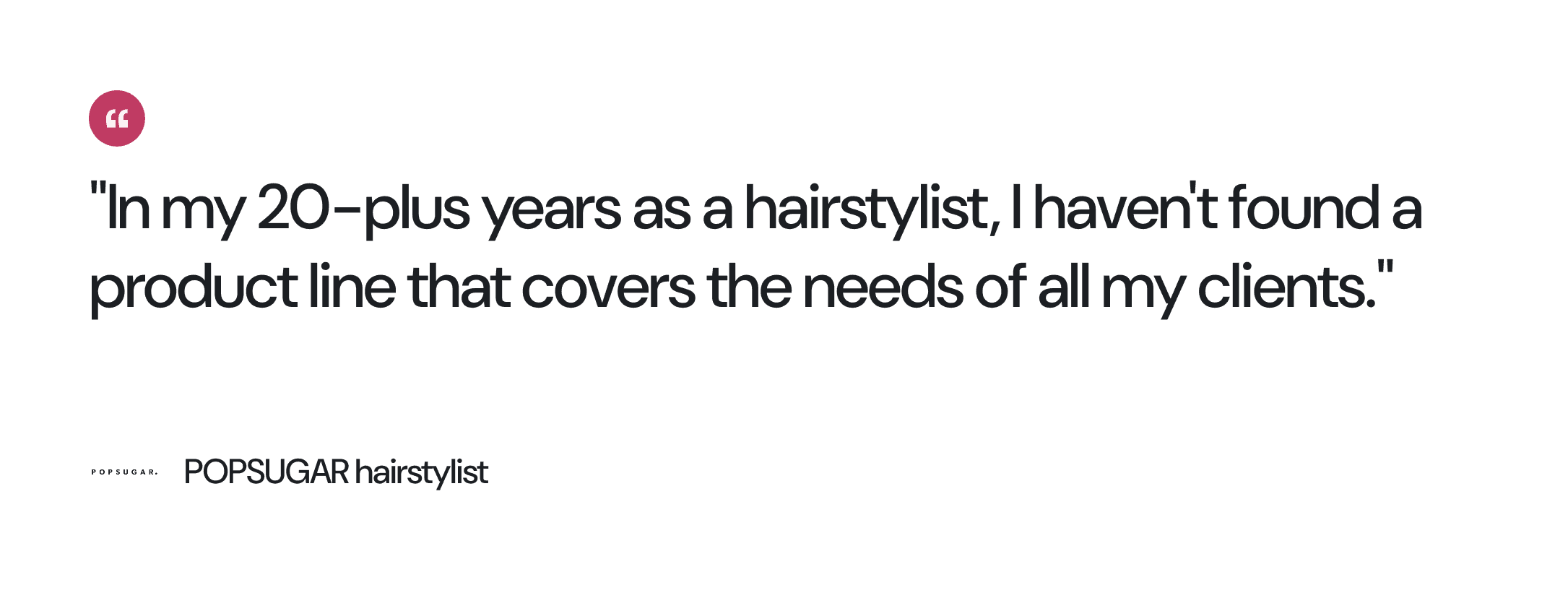
This quote from a professional with two decades of experience underscores that this isn't a consumer knowledge problem. Even experts can't find product lines that include all of their customers hair types. The gap is structural.
Competitive Analysis:
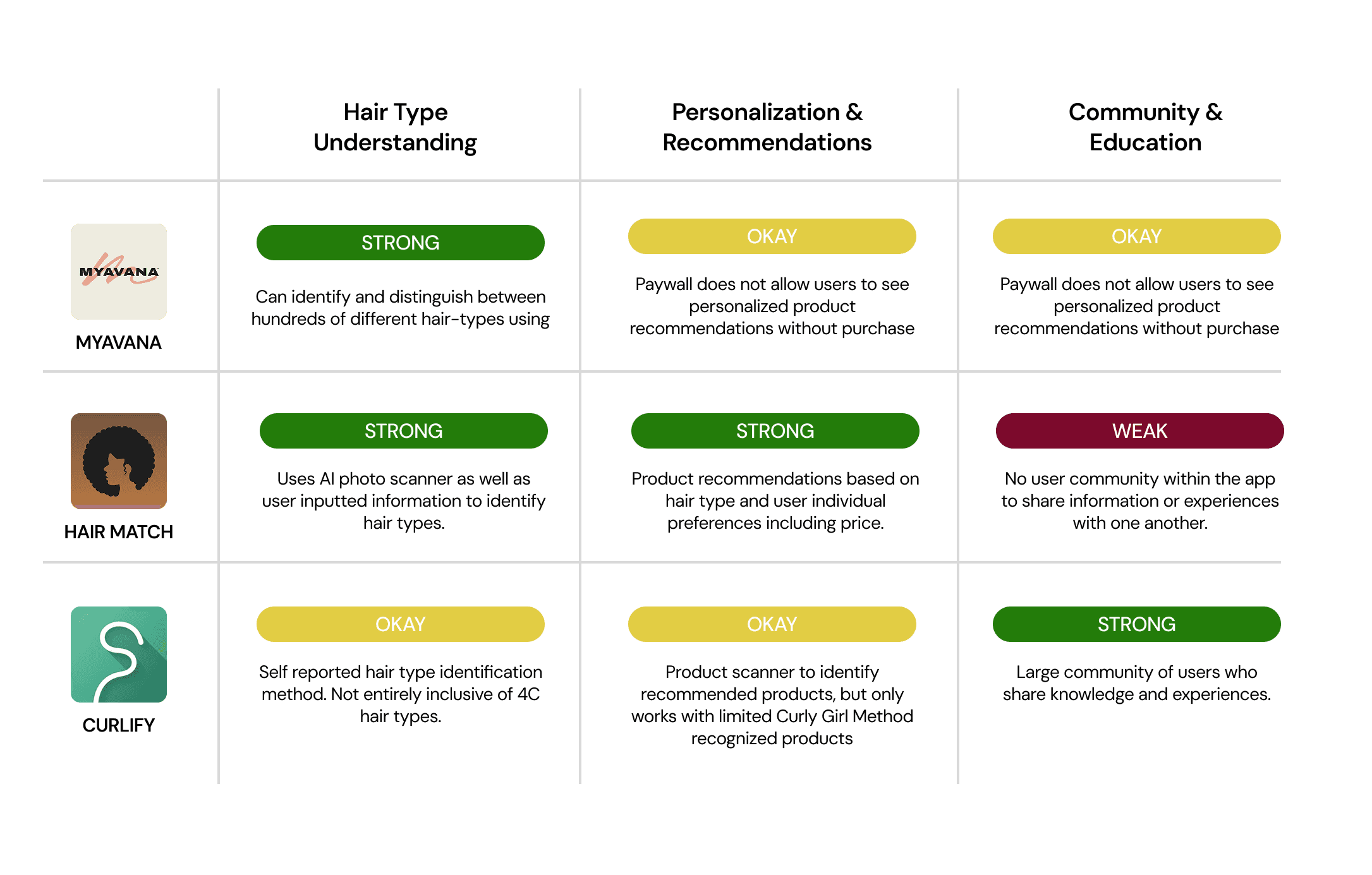
I compared the three apps most directly targeting personalized curly hair care:
The Critical Gap
Many apps focus on personalized recommendations, but few offer other user experiences to learn from and compare with.
WHAT'S MISSING ACROSS ALL PLATFORMS
User product reviews from people with similar curl profiles
Testimonials and before/after experiences
Hair care and styling tips and tricks from real users
Visual representation of similar curls for comparison
Hair products work differently depending on product layering, lifestyle, and climate. The only people who truly understand these nuances are other individuals with the same curl type. Peer knowledge is the resource that no existing platform provides.
Users
Two personas emerged representing the full spectrum of the curly hair experience; from someone still building their understanding, to someone who has spent years trying to crack the code.
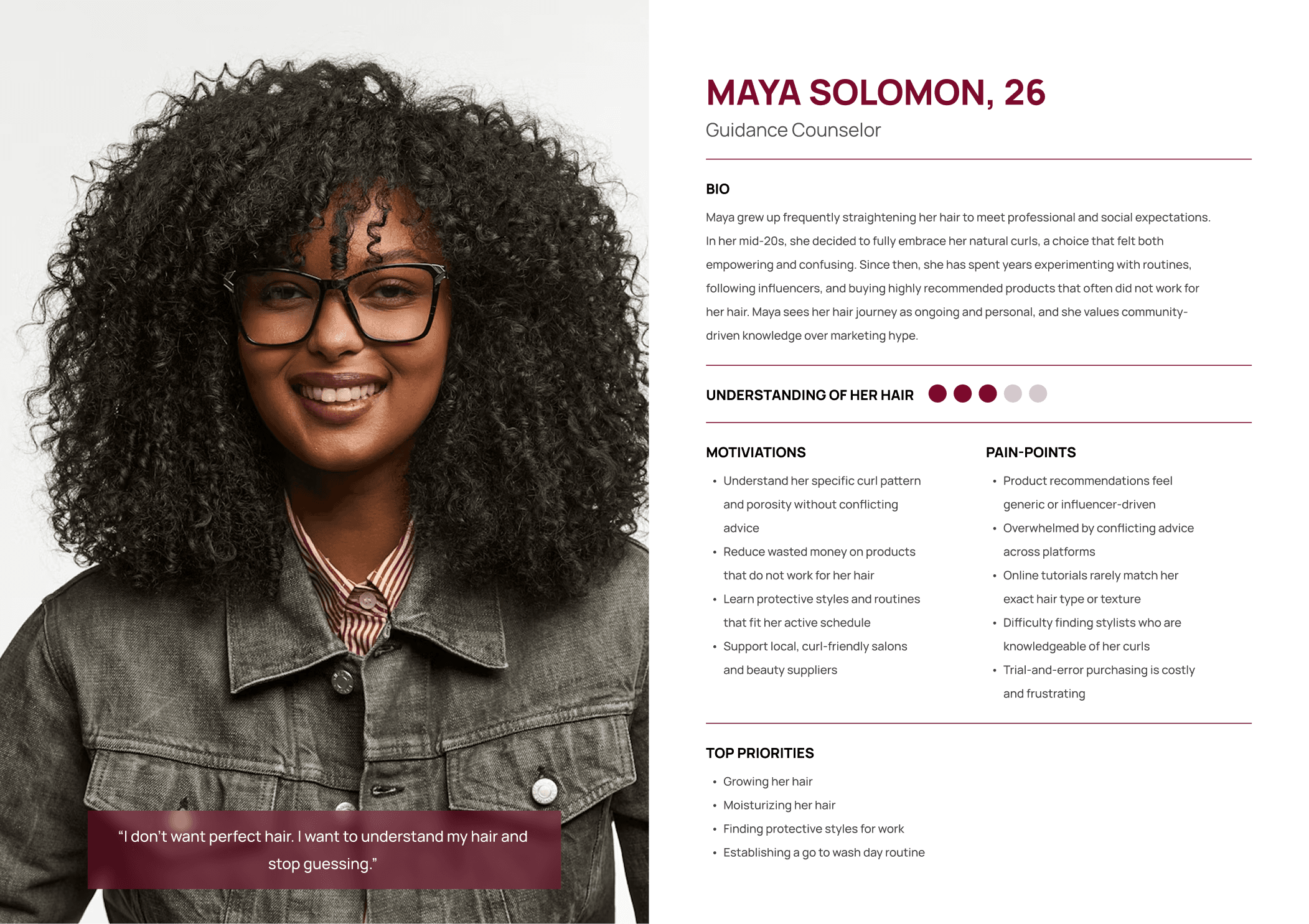
Persona 1: The Curl Veteran
Maya Solomon, 26. Guidance counselor. Grew up straightening her hair to meet professional and social expectations. In her mid-20s she decided to fully embrace her natural curls — a choice that felt both empowering and confusing. She has spent years experimenting with routines, following influencers, and buying highly recommended products that often don't work for her hair.
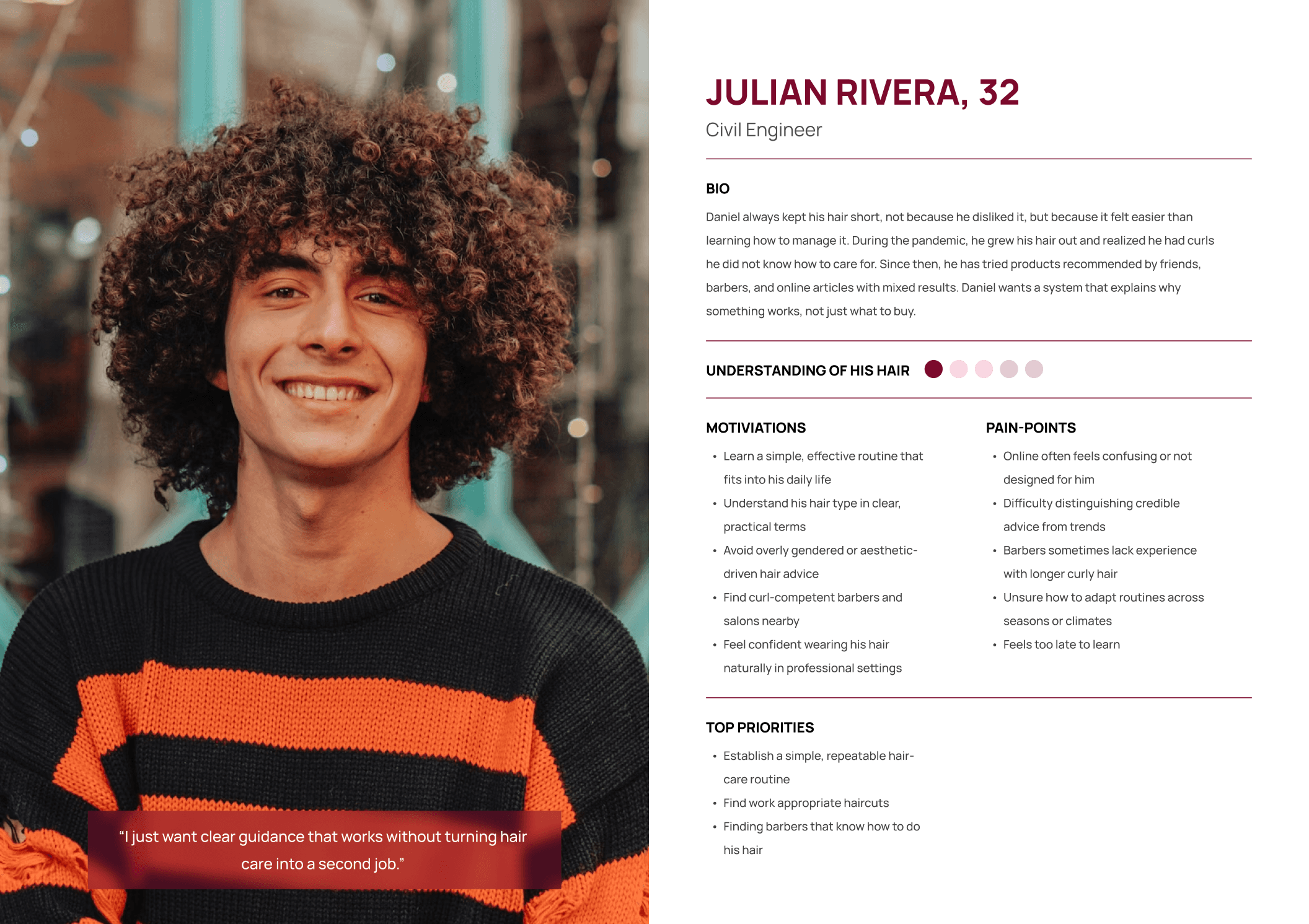
Persona 2: The Curl Newcomer
Julian Rivera, 32. Civil engineer. Always kept his hair short — not because he disliked it, but because it felt easier than learning how to manage it. During the pandemic, he grew his hair out and realized he had curls he didn't know how to care for. He has tried products recommended by friends, barbers, and online articles with mixed results.
Opportunity
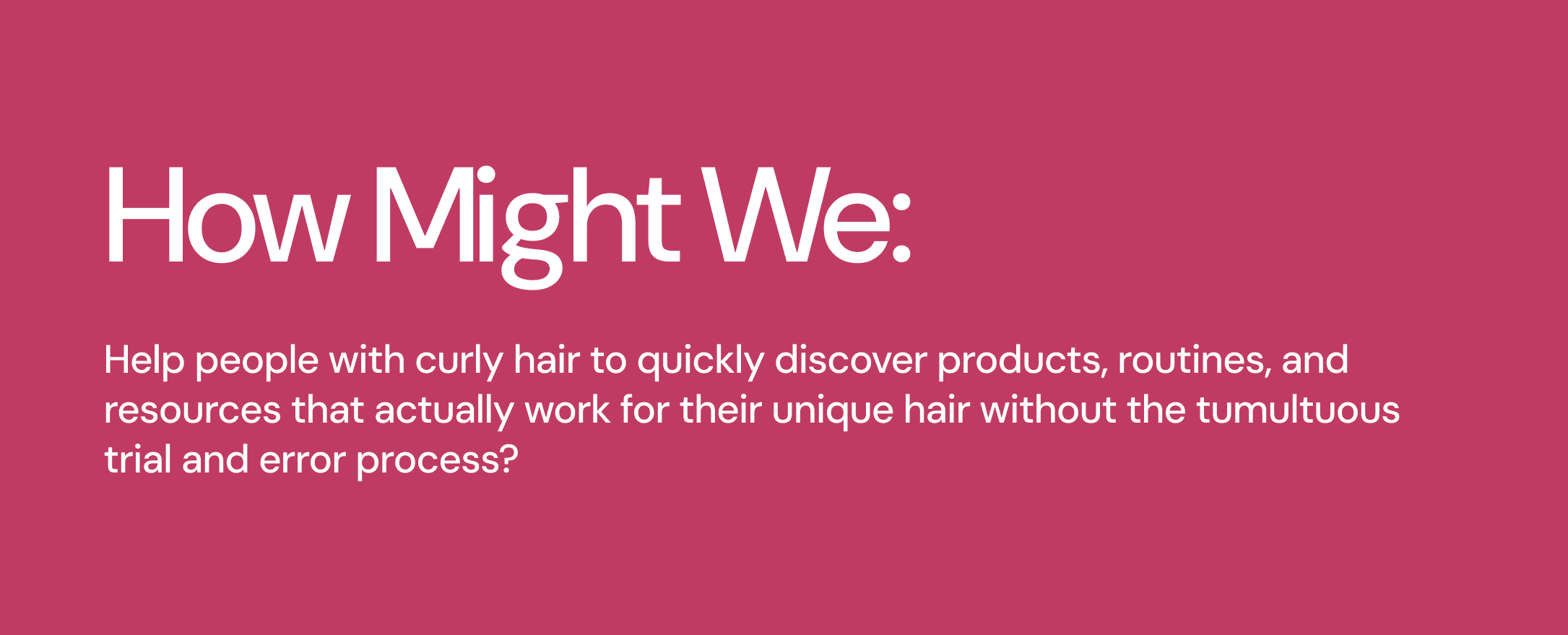
Design Principles
Personalized suggestions — recommendations specific to curl type, porosity, and lifestyle
Peer validation — real user experiences from people with similar hair
Community feeling — a space that reflects cultural diversity and shared identity
Inspiring and empowering — tone and content that builds confidence, not dependency
The Solution
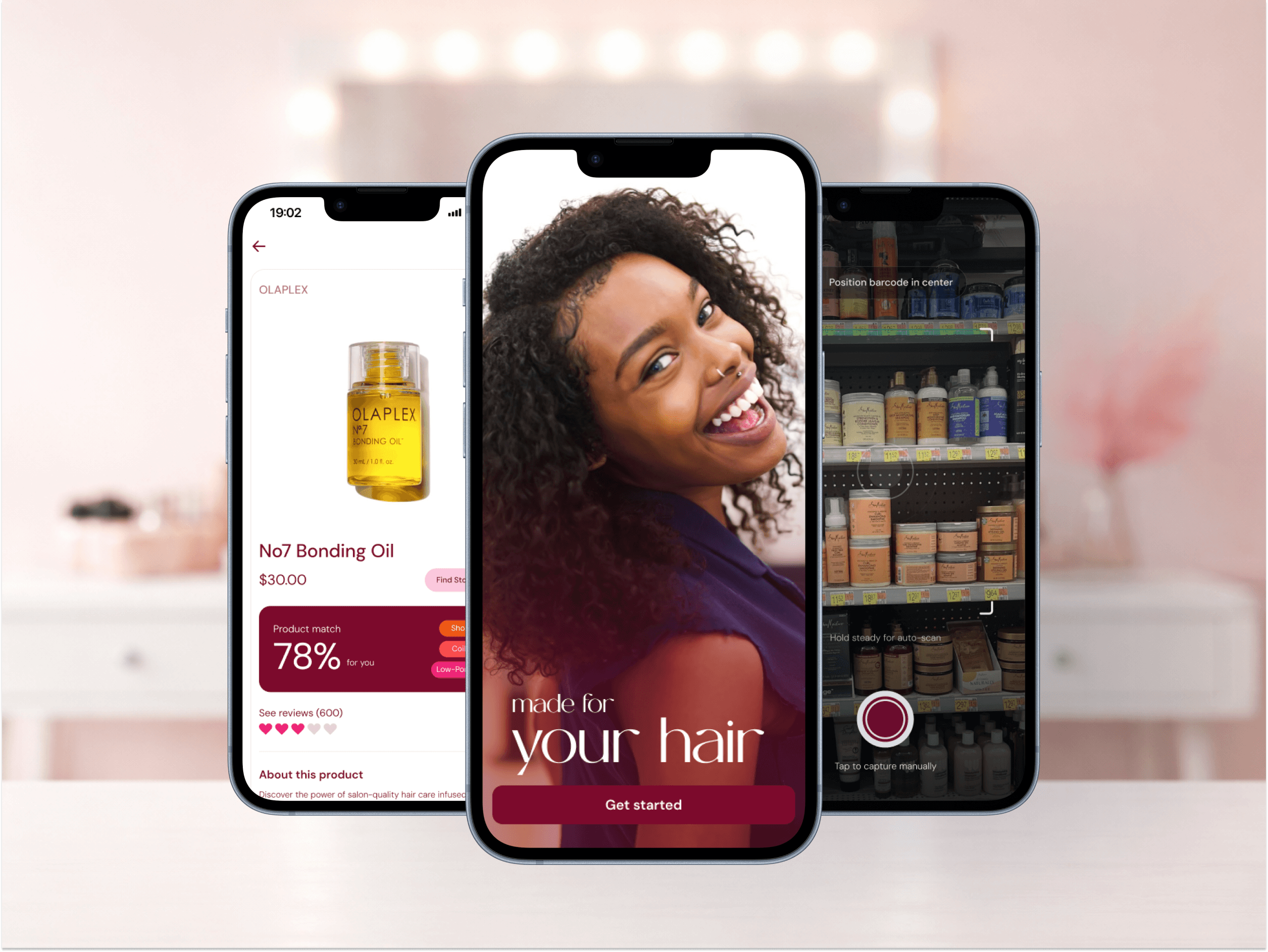
Curli is a personalized discovery platform for people with curly hair. It combines product recommendations, peer community knowledge, in-store tools, and visual tutorials, all filtered through a user's specific curl profile. The goal isn't to tell people what to buy. It's to help them understand their own hair well enough to make confident decisions.
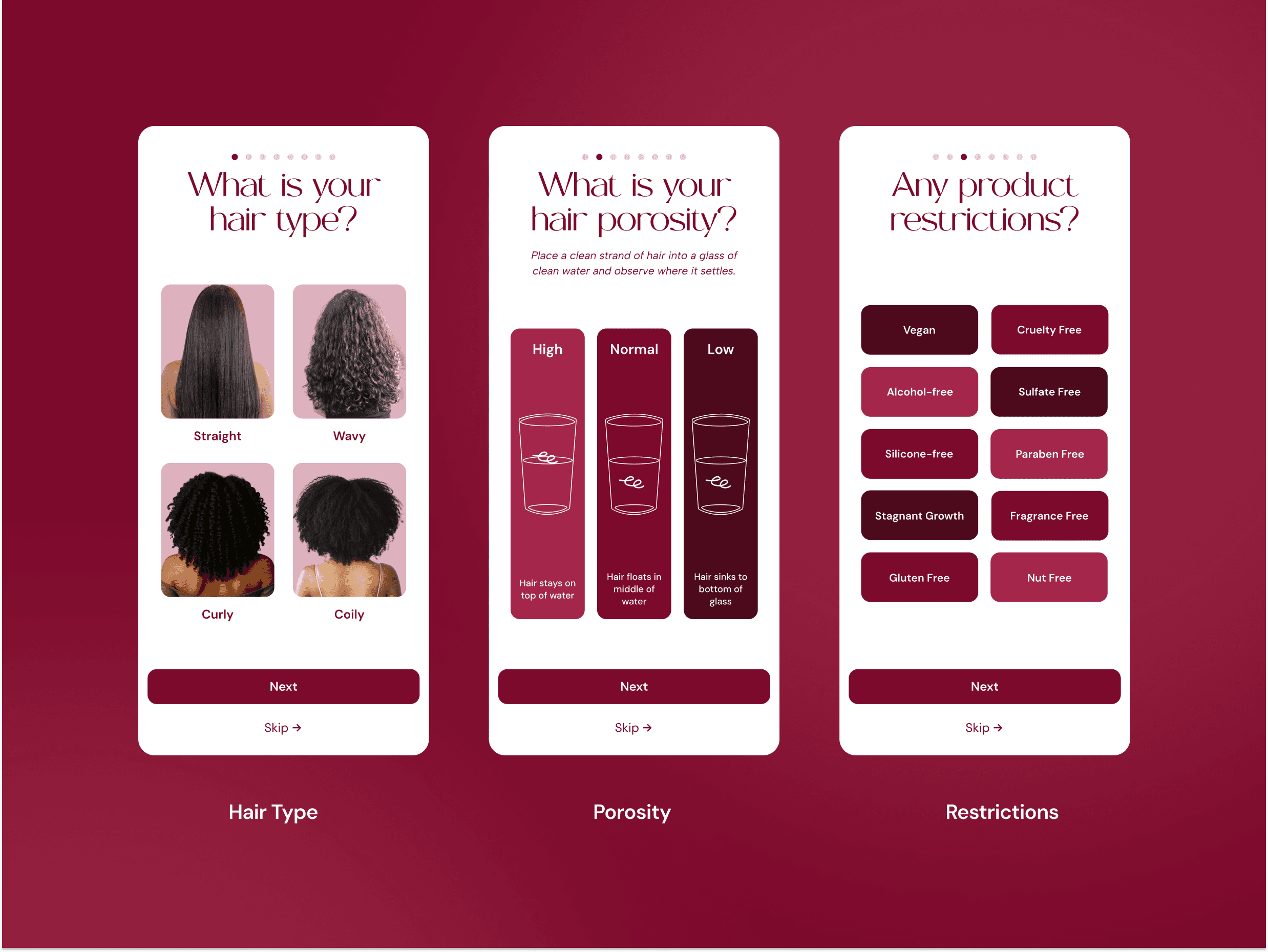
Feature 0 · Hair Profile Quiz
Before Curli can help, it needs to know you. The onboarding quiz walks you through a comprehensive set of questions covering your curl pattern, porosity, density, and scalp type — as well as your lifestyle habits, styling preferences, dietary restrictions, and product sensitivities. The more honestly you answer, the more precisely Curli can filter every product recommendation, tutorial, and piece of advice to match your actual hair — not a generic curl type.
Addresses: The core reason existing apps fail curly-haired users — they either skip personalization entirely or ask only surface-level questions that can't account for the real complexity of textured hair. Your profile becomes the engine behind every feature in the app.
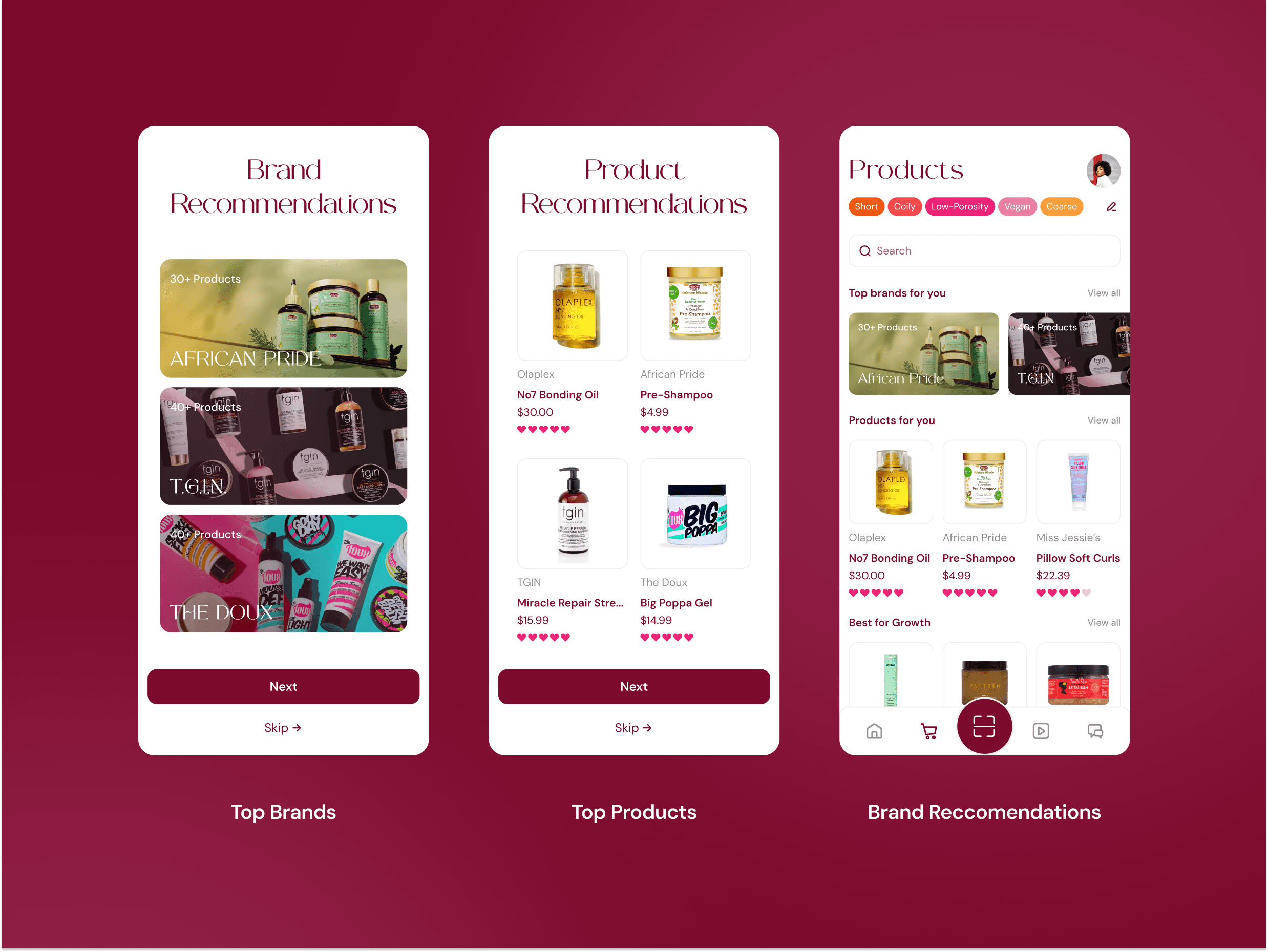
Feature 1 · AI-Powered Product Recommendations
Once you've completed the hair profile quiz, Curli gets to work. Using a combination of your hair profile data, the ingredient and chemical composition of thousands of products, and anonymized outcome data from users with similar profiles, Curli's recommendation engine surfaces the brands and products most likely to actually work for your specific hair — not just your curl type, but your porosity, density, sensitivities, lifestyle, and preferences too.
Every recommendation is ranked by compatibility, so you're never left guessing whether a product is right for you. The more users interact with Curli — saving products, rating results, updating their profile — the smarter the recommendations become across the entire platform.
Addresses: The 72% of textured-hair consumers who feel there's a gap in products designed for their needs, and the exhausting trial-and-error cycle that costs curly-haired consumers significantly more time and money than their straight-haired counterparts. Generic "best for curly hair" lists don't account for the real complexity of textured hair — Curli's recommendations do.
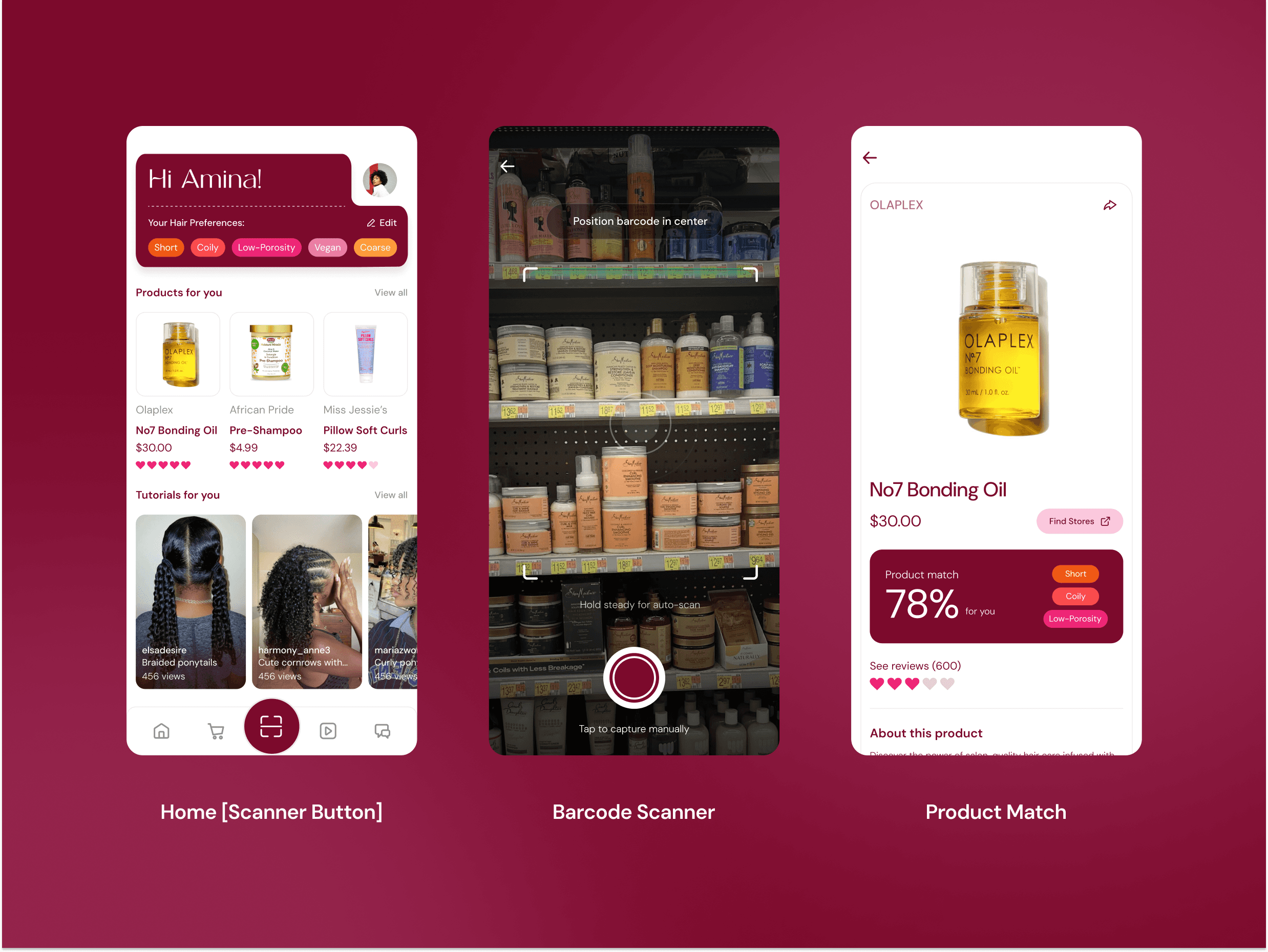
Feature 2 · Product Recommendations & Fit Assessment
Point your camera at any product barcode in a beauty supply store or supermarket and instantly see how well it matches your hair profile — before it goes in your basket. Each scan pulls up a personalized match percentage with a clear breakdown of which attributes work for your hair and which don't, plus reviews filtered to people with similar curl profiles.
No more buying blind. No more getting home to find out a product won't work for your porosity level.
Addresses: The in-store purchase problem — where most curly hair buying decisions are made without adequate information, leading to expensive, frustrating mistakes.
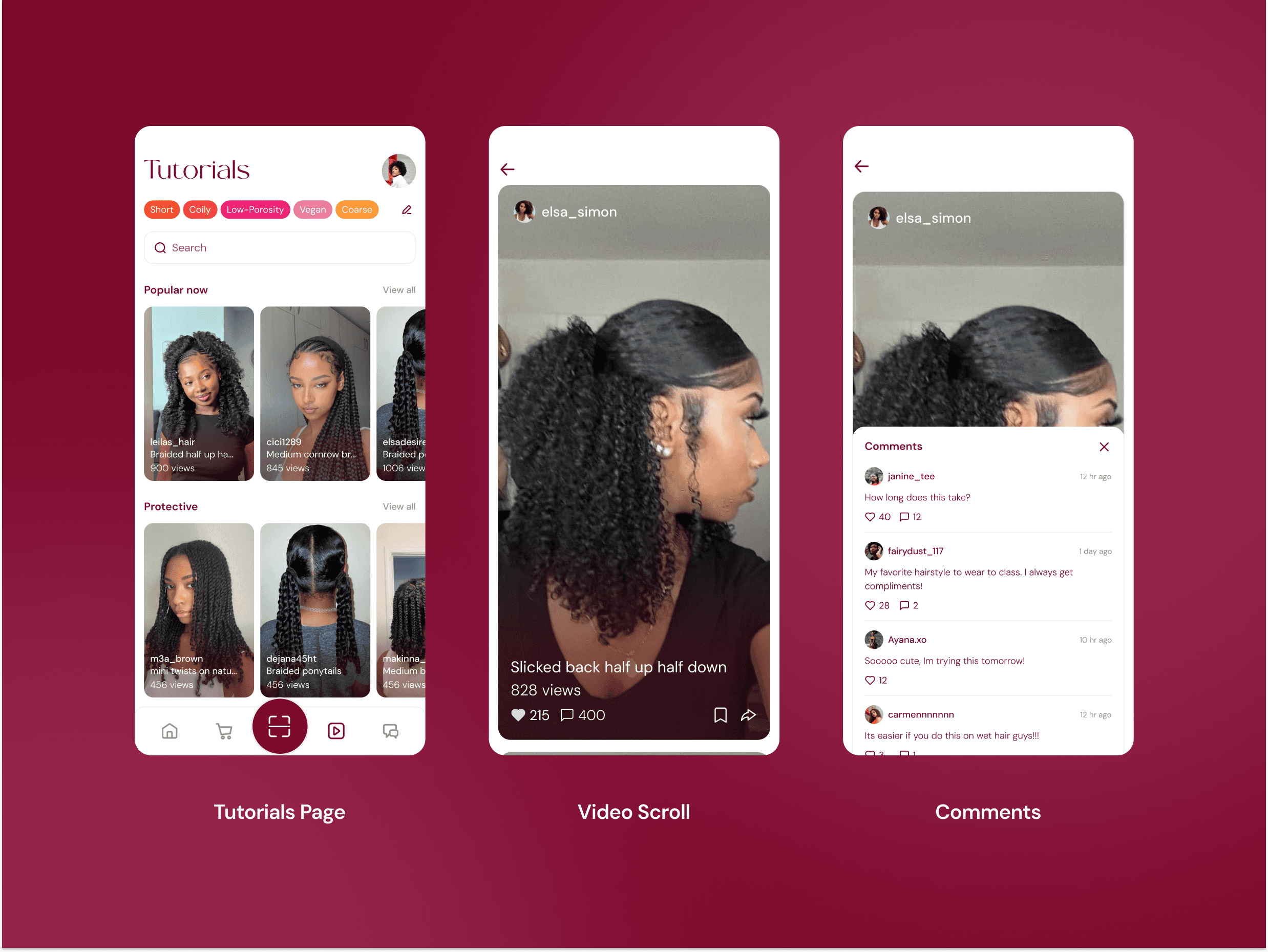
Feature 3 · Personalized Tutorials
A browsable video tutorial library filtered by curl type and style goal — Protective, Quick Braided Styles, and more. Tutorials are tagged with the creator's curl profile so users can find people who actually have the same hair. Popular and trending videos surface organically.
Addresses: Online tutorials rarely matching the user's exact hair type; the time wasted watching content that doesn't apply to your specific curls.
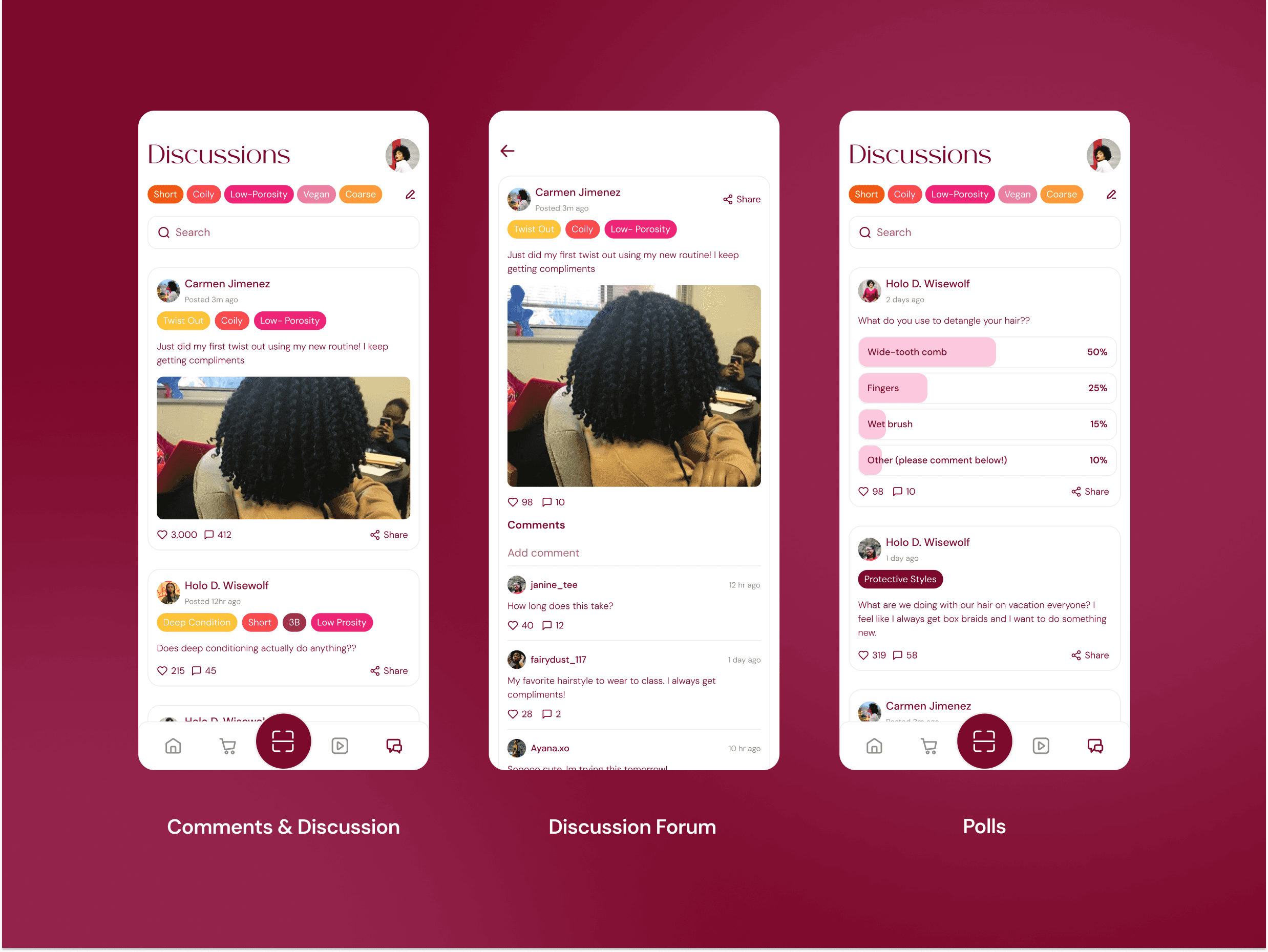
Feature 4 · Community Discussions
A peer forum where posts are tagged with the author's curl type (Short, Coily, Low-Porosity, Vegan, Gluten-free). Users can filter discussions by their own profile to find relevant experiences and advice. Real conversations from real people with similar hair — not influencer content.
Addresses: The core insight that peer knowledge is the most trusted resource for curly hair care, yet no platform currently structures it around curl profiles.
SUCCESS METRICS DEFINED
Number of successful product recommendations acted on (saved or purchased)
Product fit analysis usage rate per session
Number of successfully followed hair tutorials (completion rate)
Visits to local hair care businesses driven by app
Discussion impressions and engagement (replies, saves)
Reflection & Next Steps
Curli is the most personally meaningful of my projects. Like the majority of people with curly hair, I have also invested countless hours, dollars, and frustration into the process of finding the products that make my hair look and feel its best.
The research made clear that this isn't a niche problem, 72% of textured-hair consumers feel underserved, and the emotional weight of that gap is real. Designing something that genuinely centers the curly hair community rather than treating it as a secondary audience felt important.
The biggest design challenge was the tension between personalization depth and onboarding friction. To give relevant recommendations, you need to know a lot about someone's hair. But asking too many questions upfront drives drop-off. I resolved this by designing a progressive profiling system: start with three core attributes (curl pattern, porosity, density) and build the profile over time through usage.
With more time, I'd build and test additional features:
Local businesses: Surface curl-friendly salons, barbers, and beauty suppliers near the user
Hair diary/journal: Let users track their routine, products, and hair changes over time
Product samples: Partner with brands to send sample sizes before full purchases — reducing the financial risk of trying new products
The feature I most want to validate in testing is the in-store scanner. If it works as intended, it could fundamentally change how textured-hair consumers shop, replacing guesswork with confidence at the moment of purchase.
Design System
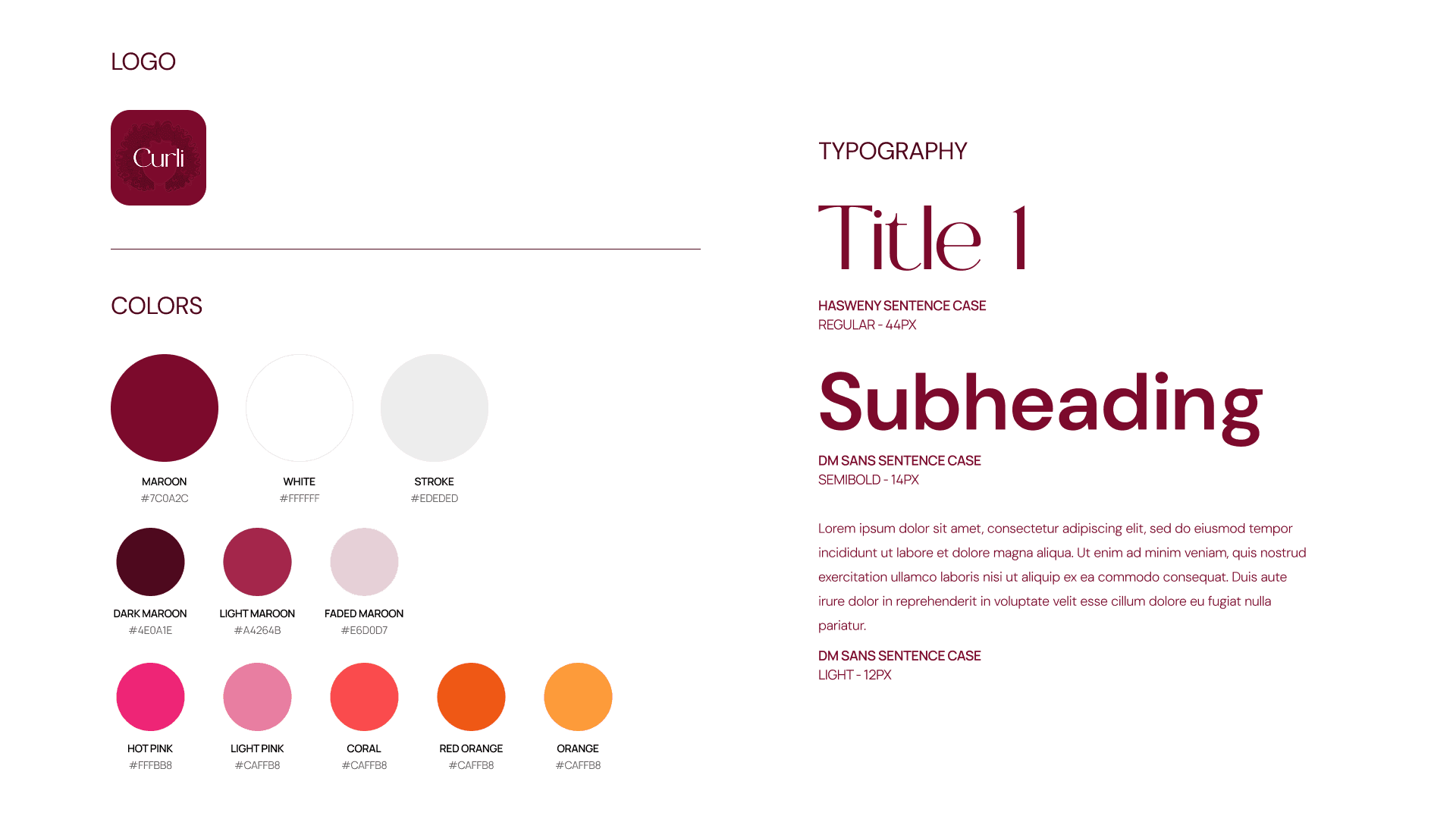
Curli's visual identity needed to feel warm, sophisticated, and community-oriented reflecting the cultural richness of the curly hair community without being reductive or generic. I was drawn to bold saturated colors that were associated with the beauty industry without leaning into an overly youthful aesthetic.